
1955 Wheat Penny Coin Value (Errors List, “D”, “S” & No Mint Mark Worth)
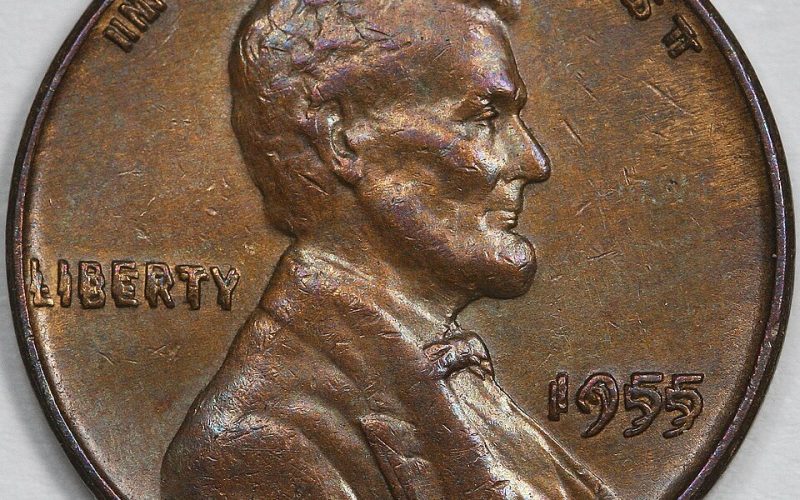
The 1955 Wheat Penny value ranges from just $0.10 for a common circulated coin to a staggering $288,000 for a high-grade Doubled Die Obverse (DDO) error, making it one of the most valuable Lincoln cents. Your coin’s worth depends primarily on its mint mark (Philadelphia no mint mark, Denver “D”, or San Francisco “S”) and whether it exhibits any error varieties. This 2026 guide breaks down current prices for all 1955 wheat pennies and shows you how to spot the most valuable errors. For a comprehensive wheat penny value reference, visit the Penny category page.
- Standard 1955 wheat pennies (no errors) are worth $0.10–$0.50 circulated and $2–$15+ uncirculated, with 1955-S commanding a slight premium due to lower mintage.
- The 1955 Doubled Die Obverse (DDO) is the king of errors, starting at $1,000 and reaching $288,000 for MS65+ Red coins; doubling is visible to the naked eye on “LIBERTY” and the date.
- Other errors like the 1955-D/D Repunched Mint Mark (RPM) add $10 to $1,000+, while BIE errors typically add only a small premium ($5–$50).
- Condition is critical: Red (RD) coins are worth 2–10× more than Brown (BN) at the same grade.
1955 Wheat Penny Values by Mint Mark: D, S & No Mint Mark
The 1955 Wheat Penny was minted at three facilities: Philadelphia (no mint mark), Denver (D), and San Francisco (S). Each mint mark produces a distinct variety with slight variations in value due to mintage numbers and collector demand. In 2026, base values for common, error-free coins are relatively modest, but condition and color can significantly increase worth. Understanding these differences helps you accurately assess your coin.
Circulated vs Uncirculated Values: 2026 Price Table for All Mint Marks
The table below shows current market ranges for standard 1955 wheat pennies in circulated and uncirculated condition. Values assume no errors and average color (Red-Brown to Brown). Exceptional Red (RD) specimens command premiums discussed later.
| Mint Mark | Circulated Value (2026) | Uncirculated Value (2026) |
|---|---|---|
| Philadelphia (No Mint Mark) | $0.10–$0.30 | $1–$5+ |
| Denver (D) | $0.10–$0.50 | $2–$10+ |
| San Francisco (S) | $0.10–$0.50 | $5–$15+ |
Uncirculated coins are worth more because they retain their original mint luster and show no wear. Even a modest grade like MS-60 can double or triple the value of a circulated coin. Mint mark influences scarcity: the 1955-S had a mintage of only 44.6 million, far fewer than the Denver (563,257,500) and Philadelphia (330.9 million) issues. This lower supply makes high-grade 1955-S pennies more valuable to collectors seeking complete mint mark sets.
Mintage Numbers Explained: Why 1955-S Is Scarcer Than 1955-D
Mintage figures directly impact the availability of coins in higher grades. The San Francisco Mint produced just 44.6 million 1955 wheat pennies, while Denver struck 563,257,500 and Philadelphia 330.9 million. This makes the 1955-S the scarcest of the three in absolute numbers. However, it’s important to note that despite these high mintages overall, error coins like the Doubled Die Obverse remain extremely rare across all mints—only a few hundred are known to exist. The 1955-S’s lower mintage does not guarantee it will have more errors; it simply means that any 1955-S, even in perfect condition, is less common than its Denver or Philadelphia counterparts.
Condition Grading Impact: How Red (RD) Coins Multiply Value
Condition is graded on the Sheldon scale from Good (G) to Mint State (MS). Color—Red (RD), Red-Brown (RB), or Brown (BN)—is a major value multiplier. For any given grade, a fully Red coin can be worth 2 to 10 times more than a Brown one. Here is a practical breakdown:
- Good (G) to Very Good (VG): Heavily worn. Color matters less, but RD still adds a small premium.
- Fine (F) to Very Fine (VF): Moderate wear. RD coins may be 2–3× BN values.
- Extremely Fine (EF) to About Uncirculated (AU): Light wear. RD begins to show significant premium.
- Mint State (MS-60 to MS-63): Uncirculated but may have contact marks. RD coins often 3–5× BN.
- MS-64 to MS-65+: High-grade with strong luster. RD coins can be 5–10× BN. For example, a 1955-S in MS-65 Red sells for $15+, while the same grade in Brown might be $2–$5.
Collectors should always check for full, original red color, as it dramatically increases value regardless of mint mark.
Why Is the 1955 Doubled Die Obverse So Valuable? Identification & Price Guide
The 1955 Doubled Die Obverse (DDO) is the most famous and valuable error in the Lincoln wheat cent series. Its dramatic doubling is visible without magnification, making it accessible to casual collectors. This error occurred at the Philadelphia Mint (no mint mark) when the die was hubbed twice in misalignment. A separate, less dramatic 1955-D DDO also exists but is distinct from the main Philadelphia variety.
What Is a Doubled Die Obverse? The 1955 DDO Error Explained
A doubled die error happens during the die-making process: the hub presses the design into the die more than once, but slightly off-center. This creates a shadow or duplicate image on the final coin. The 1955 DDO is legendary because the doubling is extreme on the obverse—especially on the date and the word “LIBERTY.” Unlike subtle doubling that requires magnification, the 1955 DDO is obvious even to the naked eye. This visibility, combined with its rarity, has made it a cornerstone of American error coin collecting.
Identifying Genuine 1955 DDO vs. Machine Doubling: Key Visual Markers
Many 1955 pennies show some doubling, but most is common “machine doubling” or “shelf-doubling” from worn dies. Genuine DDO has distinct characteristics. Use this checklist:
- Separated Doubling: The primary and secondary elements are clearly separated, not mushy or blended.
- Distinct Notches: Look for sharp notches on letters, particularly on “LIBERTY” and the date digits.
- Doubling on Date and Lettering: Both areas should show doubling; if only one area is doubled, it is likely machine doubling.
- Use 10× Magnification: Genuine DDO shows crisp, sharp edges on the doubled elements.
- Tilt Under Light: Rotate the coin to see the separation clearly; genuine DDO remains distinct from all angles.
If your coin shows these markers, it may be a valuable DDO.
1955 DDO Value Guide: Price Ranges from $1,000 to $288,000 Auction Record
The value of a 1955 DDO depends almost entirely on grade and color. Here are 2026 market ranges:
- Lower Uncirculated (MS-60 to MS-63): Starting at $1,000. These show some contact marks but still have strong doubling.
- Mid-Range (MS-64): $5,000–$15,000. Better luster and fewer flaws.
- High-End (MS-65+): $15,000–$50,000+. Excellent strike, full Red luster.
- Record Auction Price: $288,000 for an MS65+ Red specimen certified by PCGS.
Even heavily worn DDOs (grade About Good) are worth $500+ because the error is so desirable. The combination of dramatic visibility, low survival rate (only a few hundred known), and iconic status drives these prices.
Other Valuable 1955 Penny Errors: RPM, BIE & Rare Varieties
While the DDO dominates headlines, other errors on 1955 wheat pennies also add value. The most notable is the 1955-D/D Repunched Mint Mark (RPM). Smaller errors like BIE (Broken Interior Element) exist but typically contribute only modest premiums.
1955-D Error Varieties: RPM, DDO & How to Spot Them
The Denver Mint produced two main error varieties worth seeking:
- 1955-D/D Repunched Mint Mark (RPM): The “D” mint mark was punched over a previous “D,” creating a shadow or doubling inside the letter or to its right. Values range from $10 for subtle examples to over $1,000 for strong, clearly defined RPMs. Use 10× magnification to examine the mint mark under the date.
- 1955-D DDO: A less dramatic doubled die than the Philadelphia DDO, but still valuable. Worth $1,000+ in high grades. Check the same areas—date and “LIBERTY”—for separation, but the doubling is often less pronounced.
Both errors require careful inspection but can turn an ordinary 1955-D into a several-hundred-dollar coin.
BIE Errors & Other Minor Varieties: Do They Add Significant Value?
BIE (Broken Interior Element) errors occur when a die crack or chip causes missing or broken strokes in “LIBERTY” or “IN GOD WE TRUST.” These can appear on any mint mark (Philadelphia, Denver, San Francisco). BIE errors are relatively common and typically add only a small premium: $5–$50 over the coin’s base value, depending on severity and condition.
Other rare varieties like S/D overmintmarks (where an “S” is punched over a “D”) are mentioned in collector circles but are extremely scarce and not well-documented for 1955. Their scarcity makes them difficult to value, but they are not considered major varieties like the DDO or RPM.
How to Identify Valuable 1955 Pennies: Key Markers for Collectors
Follow this step-by-step checklist when examining any 1955 wheat penny:
- Check mint mark: Identify whether it has no mint mark (Philadelphia), “D” (Denver), or “S” (San Francisco).
- Examine date and LIBERTY: Use bright light and 10× magnification to look for any doubling. Genuine DDO shows clear separation.
- Inspect mint mark: On D and S coins, look for RPM—doubling inside or beside the letter.
- Assess condition: Look for full, original Red (RD) color. Avoid cleaned or damaged coins.
- Use magnification: 10× is essential for spotting subtle errors and confirming DDO vs. machine doubling.
Even an error-free 1955-S in pristine Red condition can fetch $15 or more, so always evaluate your coins carefully before spending or selling.
While 1955 was a high-mintage year for wheat pennies, the Doubled Die Obverse error is exceptionally rare—estimated at only a few hundred surviving examples—which explains its six-figure prices. If your 1955 penny shows any doubling on “LIBERTY” or the date, handle it with extreme care: avoid cleaning, store it in a soft holder, and submit it to PCGS or NGC for expert grading. Even a common 1955-S in pristine Red condition can fetch $15 or more, so always check your spare change. For collectors exploring earlier Indian Head pennies, our guides to key dates like the 1859 Indian Head Penny and 1863 Indian Head Penny provide similar detailed value breakdowns. Another essential date is the 1877 Indian Head Penny, known for its low mintage and distinct error varieties.
Frequently Asked Questions About 1955 Wheat Penny
Why is the 1955 penny worth so much?
The 1955 Doubled Die Obverse (DDO) Lincoln Wheat Penny can reach up to $288,000 in top condition due to its dramatic and easily visible doubling error, making it the most iconic U.S. error coin.
What errors are found on 1955-D pennies?
The 1955-D penny features a Repunched Mint Mark (RPM) error where the 'D' appears doubled, valued from $10 to $1,000+ depending on the prominence of the repunch.
How do I know if my 1955 wheat penny is valuable?
Value depends on mint mark and condition: Philadelphia (no mint mark) circulates for $0.10–$0.30, uncirculated $1–$5+; Denver (D) $0.10–$0.50 circulated, $2–$10+ uncirculated; San Francisco (S) $0.10–$0.50 circulated, $5–$15+ uncirculated.
Is a 1955 penny rare with no mint mark?
A regular 1955 no mint mark (Philadelphia) penny is common, not rare, with circulated values of $0.10–$0.30 and uncirculated $1–$5+. Rarity and high value apply only to specific error varieties like the 1955 Doubled Die Obverse.
Related Coins
 Penny
Penny
1962 Penny Coin Value (Errors List, “D” & No Mint Mark Worth)
Get the 2026 value of 1962 pennies. Learn pricing for "D" and no mint mark, key errors like RPM and silver dime planchet, and condition thresholds for MS-67+ gem coins.
 Penny
Penny
2009 Penny Log Cabin Coin Value (Errors List, “D” & No Mint Mark)
Get the 2026 value of 2009 Log Cabin pennies. See price charts for no mint mark and D mint, learn which errors like die gouges increase worth. Full guide.
 Penny
Penny
1999 Penny Coin Value (Errors List, “D”, “S” & No Mint Mark Worth)
A 1999 penny is usually worth just one cent, but a rare “Wide AM” error can fetch $10 to $75 or more—with record sales exceeding…