
1990 Penny Coin Value (Errors List, “D”, “S” & No Mint Mark Worth)
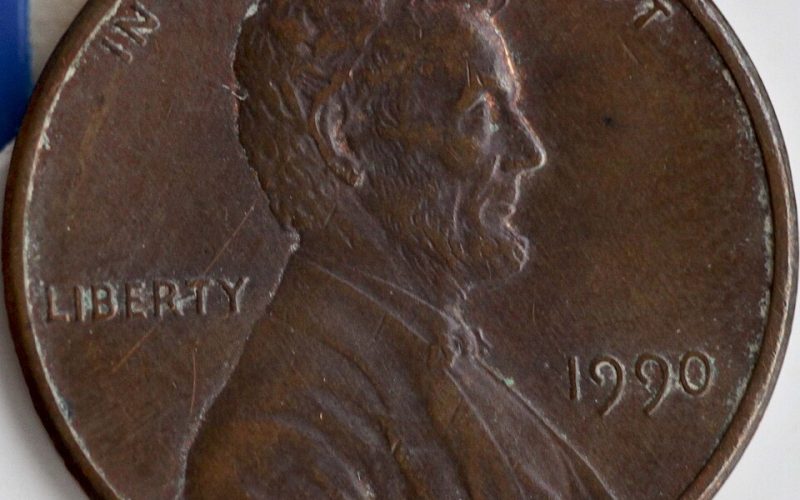
A 1990 penny is typically worth just one cent, but the rare 1990 No-S Proof penny can fetch $4,000 to $10,000 or more in top condition. This error coin, missing the San Francisco mint mark on a proof strike, represents the pinnacle of 1990 penny values. For collectors, understanding the differences between mint marks (D, S, no mint mark), errors, and grading is essential to identifying valuable specimens in circulation or proof sets. This guide breaks down current 2026 market values for all 1990 penny varieties, highlighting the key varieties that command premiums and the specific errors to look for when examining your coins.
- The 1990 No-S Proof penny is the most valuable, worth $4,000–$10,000+ in PR-69 condition due to a missing mint mark error.
- Standard 1990-D and no mint mark pennies are worth 1 cent circulated, but high-grade (MS65+) examples fetch $10–$25+; a 1990-D in MS69 red sold for $500.
- Key errors to find: the No-S Proof, a 1990-D struck on a 3.1g copper planchet (weigh it!), and potential Wide AM or Doubled Die varieties.
- Condition is critical: “Full Red” Mint State (MS67-68+) or high-grade proofs (PR-69) are required for significant premiums.
1990 No-S Proof Penny Value: The $4,000–$10,000+ Rarity
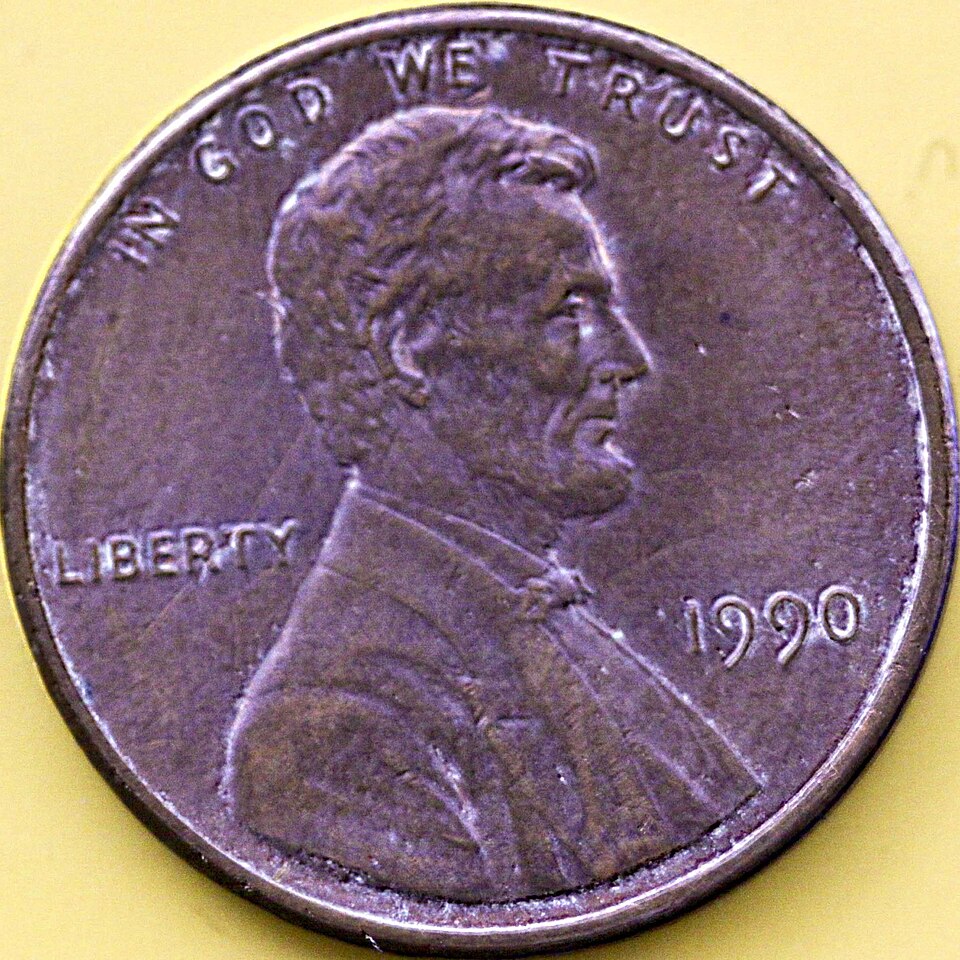
The 1990 No-S Proof penny is the most valuable 1990 penny variety, with prices ranging from $4,000 to over $10,000 for high-grade examples. This extraordinary value stems from a minting error where a small number of proof coins from the San Francisco Mint were struck without the “S” mint mark. Unlike standard 1990-S proof pennies worth $3-$10, the No-S variety is a rarity among Lincoln cents, with fewer than 100 known examples. Collectors actively seek these coins, and certified specimens in PR-69 condition command the highest prices. Understanding how to identify, grade, and authenticate a 1990 No-S Proof is crucial for any collector hoping to find or evaluate this valuable error.
1990-S No-S Proof Value: $4,000–$10,000+ Range
| Proof Grade | Value Range (2026) |
|---|---|
| PR-65 | $4,000 – $6,000+ |
| PR-66 | $5,000 – $7,500+ |
| PR-67 | $6,000 – $8,500+ |
| PR-68 | $7,000 – $9,500+ |
| PR-69 | $4,000 – $10,000+ |
Note: Values are for coins certified by major grading services (PCGS, NGC). Ungraded or lower-grade examples may be worth less. Standard 1990-S proof pennies with the “S” mint mark are valued at $3-$10 in similar grades.
The value progression shows that higher grades command premiums, with PR-69 being the pinnacle. The wide range at PR-69 reflects the coin’s rarity and the competitive market among high-end collectors. A PR-69 No-S Proof can exceed $10,000 if it exhibits exceptional cameo contrast and flawless surfaces. In contrast, a standard 1990-S proof with the “S” mint mark is a common variety worth only a few dollars, highlighting how a single missing mint mark transforms a common coin into a treasure. When evaluating a potential No-S Proof, always verify its authenticity through a reputable grading service, as counterfeits and altered coins exist.
How to Identify a Genuine 1990 No-S Proof Penny
- Confirm it’s a proof coin: Look for mirror-like fields (the background) and frosted devices (the raised design elements). Proof coins have a distinctive cameo appearance with high contrast. They were struck with specially polished dies and planchets, resulting in a sharp, detailed finish. Circulation strikes never achieve this level of detail and luster.
- Locate the mint mark: On the reverse (tails side) of the Lincoln Memorial cent, the mint mark appears below the wreath, centered at the bottom. For a genuine 1990 No-S Proof, this area should be completely smooth with no trace of an “S” mint mark. Use magnification (10x or higher) to inspect for any signs of polishing or alteration that might have removed an “S”.
- Check for other 1990-S proof features: Genuine 1990-S proof coins exhibit sharp details, a strong strike, and excellent cameo contrast between the frosted devices and mirror fields. The date and lettering should be crisp. Any weakness or blurriness suggests a circulation strike or a poorly made fake.
- Rule out damage or tampering: Examine the coin under good light for any tool marks, scratches, or inconsistencies in patina that indicate the mint mark was removed after striking. A genuine No-S will have a smooth, undisturbed surface where the mint mark should be. Also, check that the coin’s weight (2.5 grams for zinc-core) and dimensions are correct; copper-plated zinc planchets were standard in 1990.
Only proof set coins from San Francisco can have this error; circulation strikes from Denver or Philadelphia never bear an “S” mint mark. Therefore, any 1990 penny without an “S” that appears to be a circulation strike is simply a Philadelphia or Denver coin and not valuable. The No-S Proof is exclusively a proof variety. If you suspect you have one, handle it carefully and consider professional grading to authenticate and preserve its value.
Why the 1990 No-S Proof Is So Rare: A Minting Mistake
The 1990 No-S Proof penny resulted from a rare minting error at the San Francisco Mint. During the production of 1990 proof sets, a small batch of dies was prepared without the “S” mint mark, either due to an oversight or a die preparation mistake. These undated dies were then used to strike coins that were inadvertently included in proof sets. This error is unique among Lincoln Memorial cent proof issues spanning more than a century; no other proof cent in the series is known to have been struck without its intended mint mark. Mintage estimates suggest that fewer than 100 examples of the 1990 No-S Proof exist today, making it one of the rarest Lincoln cent varieties. The combination of extreme rarity, the dramatic nature of the error (a missing mint mark on a proof coin), and strong collector demand drives its high value. In contrast, standard 1990-S proof pennies are abundant, with millions minted, and trade for only $3-$10 even in high grades. The No-S Proof stands as a testament to how a single small oversight in the minting process can create a coin worth thousands of dollars.
1990-D and No Mint Mark Penny Values: From 1 Cent to $500
1990 pennies from the Denver Mint (with a “D” mint mark) and from the Philadelphia Mint (with no mint mark) are common in circulation and usually worth only face value. However, high-grade examples in Mint State condition can fetch $10 to $25 or more, and exceptional specimens reach $500. The Denver issue also has a rare copper planchet error that adds significant value. This section breaks down the values for both mint marks and explains how to spot the valuable copper planchet anomaly.
1990-D Penny Value: From Face Value to $500 for MS69 Red
| Grade Range | Value Range (2026) |
|---|---|
| Circulated (G-4 to VG-8) | $0.01 (face value) |
| Mint State (MS-60 to MS-64) | $0.25 – $2 |
| High Mint State (MS-65 to MS-66) | $10 – $25 |
| Gem Quality (MS-67 to MS-69) | $50 – $500+ |
Note: Values increase significantly for coins with Full Red color. The benchmark $500 sale refers to an MS69 red example certified by PCGS. Lower color (Red-Brown or Brown) reduces value.
The value jump from MS-66 to MS-67 is substantial, reflecting the scarcity of gems. A 1990-D in MS-69 with Full Red luster is exceptionally rare and can exceed $500, as demonstrated by a notable sale. Most 1990-D pennies found in circulation are heavily worn and hold no premium. Collectors seeking high-grade examples should focus on uncirculated rolls or purchase from reputable dealers. The Denver Mint produced over 4 billion 1990 pennies, so the supply is huge, but high-grade survivors are limited due to heavy circulation.
1990 No Mint Mark (Philadelphia) Penny Value: $10–$25 for MS65+
Philadelphia-mint 1990 pennies bear no mint mark, as was the tradition for the main mint. In circulated condition, they are worth exactly one cent. However, when found in high grades (MS-65 and above), these coins become collectible, with values ranging from $10 to $25. This price range is nearly identical to the 1990-D in comparable grades, as both are common mint marks with similar survival rates in top condition. A key difference: Philadelphia pennies cannot have repunched mint marks (RPMs) because there is no mint mark to repunch. Denver pennies sometimes exhibit RPM varieties, but these are minor and not major value drivers. For collectors building a complete set of 1990 pennies, high-grade no-mint-mark examples are essential, and they trade actively in the $10-$25 range when certified by PCGS or NGC.
1990-D Copper Planchet Error: The 3.1g Weight Anomaly
The most significant error for the 1990-D penny is the copper planchet strike. In 1990, the U.S. Mint used copper-plated zinc planchets weighing 2.5 grams for all cents. However, a small number of leftover pre-1983 copper planchets (weighing 3.1 grams) were accidentally used at the Denver Mint. These coins are heavier, have a distinct copper color throughout (not just plated), and produce a higher-pitched ring when dropped on a hard surface. The error is rare and highly desirable, often commanding premiums of $500 or more depending on grade. A PCGS-graded MS64 brown example of this error is documented, and higher-grade Full Red specimens could be worth even more.
To identify a copper planchet error, weigh the coin precisely with a digital scale accurate to 0.01 grams. A weight of 3.1 grams (or even 3.0-3.2 grams due to wear) indicates a copper planchet. Visually, the coin may appear more uniformly copper-colored, lacking the slight zinc core visible on worn standard coins. The edge may also show a different color. This error is specific to 1990-D; no mint mark and proof pennies are not affected because they were not struck at Denver in 1990. Finding a 1990-D that weighs 3.1 grams is a major discovery—weigh every 1990-D you encounter.
Grading and Condition: How MS65+ and Full Red Affect 1990 Penny Prices
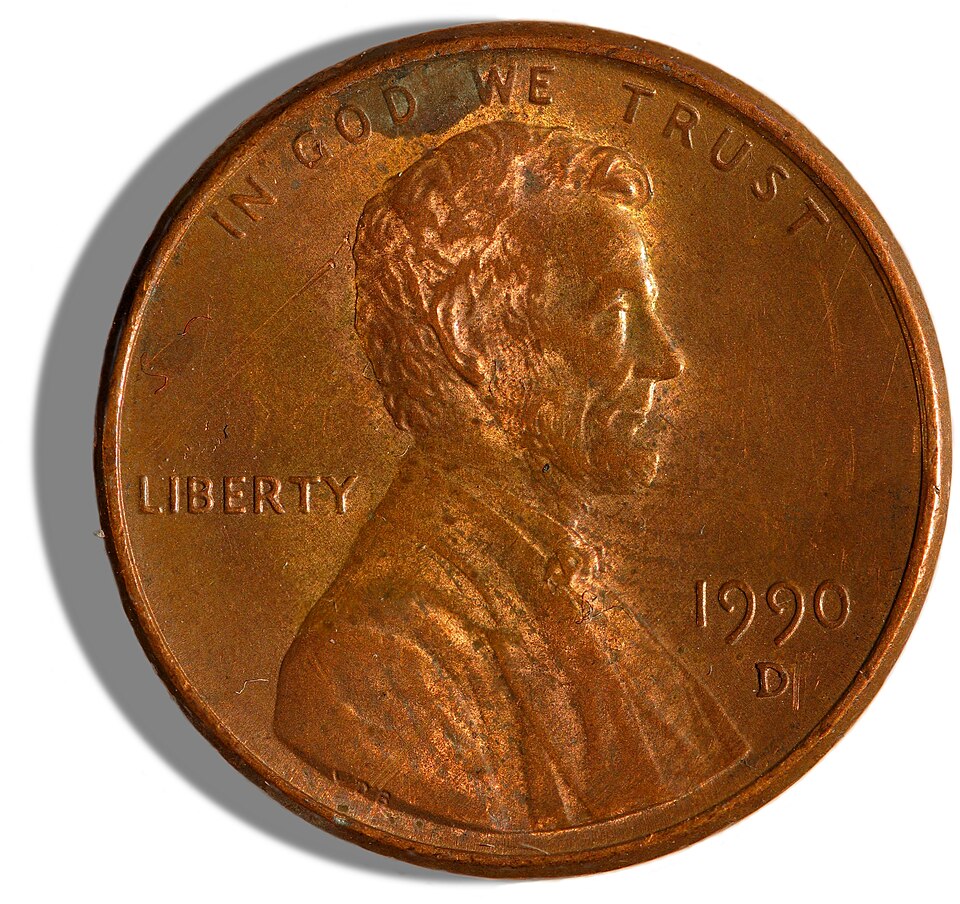
Condition is the single most important factor determining a 1990 penny’s value beyond its mint mark and error status. For standard varieties (no mint mark and D), the threshold for collector premiums is MS-65. Above this grade, values rise sharply, especially when the coin retains its original Full Red color. Proof coins follow a separate grading scale, with PR-69 required for top dollar on the No-S variety. Understanding these grade thresholds and color designations is essential for accurately assessing what a 1990 penny is worth.
Grade Thresholds: MS65+ Unlocks $10–$25 Values
| Grade | Value Range (Standard 1990 Penny) |
|---|---|
| MS-60 / MS-61 | $0.25 – $1 |
| MS-62 / MS-63 / MS-64 | $1 – $5 |
| MS-65 / MS-66 | $10 – $25 |
| MS-67+ | $50+ (can reach hundreds for exceptional examples) |
Note: These ranges apply to both no mint mark and D mint mark pennies in similar color (Full Red or Red-Brown). Full Red coins command the higher end of each range.
The jump from MS-64 to MS-65 is critical; it marks the transition from coins with noticeable flaws to those suitable for registry sets. MS-65 is defined as a coin with no more than four or five minor contact marks, all of which are small and located away from the design’s focal points. At MS-67 and above, the coin must be essentially flawless, with sharp details and full original luster. Given the high mintage of 1990 pennies, surviving examples in MS-67 or better are scarce, which explains the steep price increase. For the average collector, finding a 1990 penny in MS-65 or MS-66 is already a notable achievement and yields a $10-$25 coin instead of face value.
Proof Grades vs Mint State: PR-69 for No-S, MS-69 for D
Proof and Mint State coins are graded on the same 70-point scale, but the criteria differ significantly. Proof (PR) coins are struck from polished dies on specially prepared planchets, resulting in mirror-like fields and frosted devices. Grading focuses on the quality of the cameo contrast, the absence of blemishes, and the overall aesthetic. Mint State (MS) coins are regular circulation strikes evaluated on luster, strike quality, and the number and severity of contact marks. For the 1990 No-S Proof, a grade of PR-69 is essential to reach the $4,000-$10,000+ range; PR-68 examples may be worth half as much. For the 1990-D, the peak value of $500+ requires an MS-69 (or at least MS-68) with Full Red color. An MS-69 proof coin is not equivalent to an MS-69 circulation strike; the proof grade demands even stricter standards for surface perfection and contrast. Collectors must understand these distinctions to avoid mispricing and to set realistic expectations when buying or selling.
Full Red vs Red-Brown: The Color Impact on 1990 Penny Prices
Copper-plated zinc cents, including all 1990 pennies, are assigned a color designation that significantly affects value. Full Red (FR) means the coin retains at least 95% of its original mint red color, with only minor brownish areas, typically on the highest points. Red-Brown (RB) indicates an approximately equal mix of red and brown, while Brown (BN) means the coin has mostly lost its original color. For high-grade 1990 pennies (MS-65 and above), Full Red coins command premiums of 2 to 5 times over RB or BN examples at the same grade. A 1990-D in MS-66 Full Red might sell for $25, while the same grade in RB might fetch only $5. The reason is simple: original mint luster is prized by collectors and degrades over time due to handling and environmental exposure. To assess color, view the coin under bright, natural light, rotating it to see the overall hue. Storage in airtight holders or Mylar flips helps preserve Full Red. When buying, always verify the color designation from the grading service’s label, as it is a major value driver.
The most valuable 1990 penny isn’t from a rare mint mark combination—it’s from a proof coin that’s missing its mint mark entirely, turning a common proof into a $10,000+ rarity. This shows how a single missing letter can create extraordinary value. For circulation strikes, the key is condition and errors: a 1990-D in MS-69 red sold for $500, and a copper planchet error can double that value. Immediately check the reverse of any 1990 proof penny you encounter. If the “S” mint mark is absent below the wreath, you may have a $5,000+ coin—handle it with care and seek professional authentication. For circulation strikes (1990-D or no mint mark), weigh them precisely; a weight of 3.1 grams indicates a copper planchet error worth hundreds. Always verify mint marks under magnification and consider submitting high-grade coins to PCGS or NGC for certification to maximize their market value.
Frequently Asked Questions About 1990 Penny
What to look for on a 1990 penny?
And start with the 1990 Lincoln cent. This penny has been broadstruck. So that is a genuine mint error here you can see how it's stretched out around the rim of the coin.
What is the most valuable penny from the 1990s?
The 1992 Close AM and 1992-D Close AM (the “D” is for Denver) are some of the rarest and most valuable coins from the 1990s. According to the PCGS, the U.S. Mint adjusted the penny's design slightly in '92 to enable a higher-quality strike.
What does a 1990 No-S Proof penny look like?
But on a small number of coins. There is no S mint mark. And if you have this coin it is worth a lot of money. But remember this has to be the proof coin from the proof.
How much should a 1990 D penny weigh?
1990-D 1C Cent — Struck on a Pre-1983 3.1-gm Copper Planchet — MS64 Brown PCGS. The 3.1-gm weight of this copper planchet corresponds to the pre-1983 coinage period, as the PCGS holder indicates. In 1990, the Mint was eight years into using copper-plated zinc planchets that weighed only 2.5 gm.
Related Coins
 Penny
Penny
1912 Penny Coin Value (Errors List, “D”, “S” & No Mint Mark Worth)
A 1912-S wheat penny in MS-65 RB condition can fetch $4,500-$7,500, making it the most valuable regular-issue 1912 cent. The three mint marks—Philadelphia (no mint…
 Penny
Penny
1994 Penny Coin Value (Errors List, “D”, “S” & No Mint Mark Worth)
1994 Penny Coin Value (Errors List, “D”, “S” & No Mint Mark Worth) A 1994 penny is generally worth face value ($0.01) in circulated condition,…
 Penny
Penny
1907 Indian Head Penny Coin Value (Errors List & No Mint Mark Worth)
In 2026, a 1907 Indian Head Penny in Good-4 condition sells for $1.60, while Mint State examples reach $553, making condition the primary value driver.…