
2017 Penny Coin Value (Errors List, “P”, “S” & “D” Mint Mark Worth)
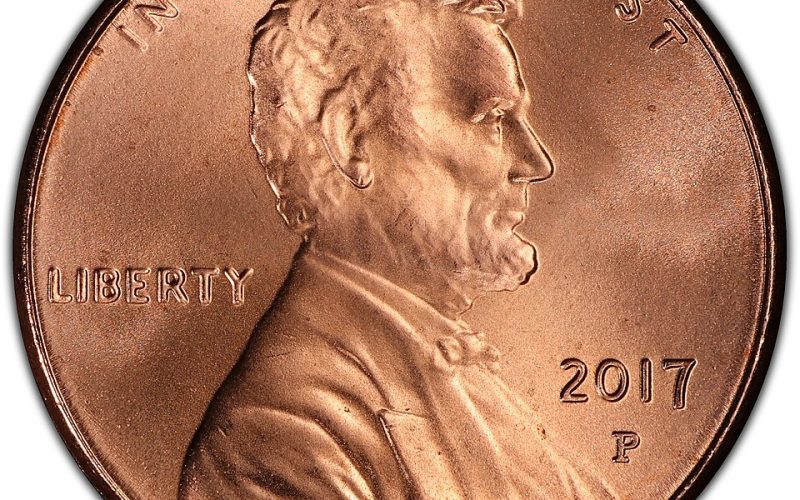
The 2017 Penny (Lincoln Shield cent) is a modern landmark: it’s the first penny struck at the Philadelphia Mint with a “P” mint mark, appearing under the date. This tiny letter transforms an ordinary zinc cent into a key date. In 2026, values range from $0.01 for well-worn circulation pieces to over $250 for pristine high-grade examples. All three active mints—Philadelphia (P), Denver (D), and San Francisco (S)—produced 2017 pennies, each with distinct price tiers based on mint mark, condition, and rarity. This guide delivers current market data, error varieties, and actionable tips for identifying valuable 2017 pennies in your change.
- The 2017-P (Philadelphia) is the first U.S. cent with a “P” mint mark, making high-grade examples (MS66-MS68) worth $5 to over $250.
- 2017-D (Denver) cents are common in circulation but fetch premiums in MS64 and higher condition.
- 2017-S (San Francisco) proof pennies are the most valuable, with PR69DCAM starting around $7 and increasing for higher grades.
- Error coins (like die clashes) are rare but can add significant value ($40+), while most “errors” are just post-mint damage.
2017 Penny Value by Mint Mark: P, D, and S (2026 Prices)
The 2017 Lincoln Shield cent was minted at all three active facilities, creating three distinct market segments. Philadelphia introduced the “P” mint mark for the first time on a cent to commemorate the Mint’s 225th anniversary, making it the most historically significant. Denver produced the bulk of circulation coins, while San Francisco struck only proof versions for collectors. Understanding the baseline values for each mint mark in average circulated condition versus high uncirculated grades is essential for any collector.
What’s Special About a 2017 P Penny?
The 2017-P penny’s special status stems from a historic first: it’s the inaugural Lincoln cent to bear a “P” mint mark, commemorating the Philadelphia Mint’s 225th anniversary. Prior to 2017, Philadelphia cents carried no mint mark—a tradition stretching back to the 19th century. The “P” sits under the date on the obverse, a subtle but revolutionary change.
In everyday circulation, 2017-P pennies are worth face value: $0.01. Billions were minted and released, making them common in change jars. Collector demand, however, drives premiums for exceptionally preserved specimens. The threshold for significant value begins at MS66 (Mint State 66) on the Sheldon scale. At this grade, coins show no visible flaws under 5x magnification and possess full original luster. Current 2026 market data indicates MS66 examples start around $5. As condition improves to MS67 and the pinnacle MS68, values climb rapidly. High-grade MS68 specimens can exceed $250, with some auction results surpassing that for perfect examples. These prices assume the coin is error-free and has original surfaces.
The zinc-based composition (97.5% zinc, 2.5% copper plating) makes achieving high grades challenging. Zinc is softer than copper and more prone to surface marks, corrosion, and planchet imperfections. Even a minor scratch can drop a coin from MS66 to MS65, halving its value. Consequently, high-grade 2017-P pennies are scarce despite the high mintage. Collectors should also be aware that many “P” mint marks on 2017 pennies are weak or partially missing; a clear, fully struck “P” is essential for top value.
The 225th anniversary of the Philadelphia Mint was celebrated throughout 2017 with special coin releases and events. The “P” mint mark on cents was a quiet but significant part of that celebration, instantly creating a new modern key date. Unlike the 2009 Lincoln bicentennial cents which had special reverse designs, the 2017-P’s only distinguishing feature is the mint mark, making condition even more critical. Collectors should be aware that the U.S. Mint also produced enhanced uncirculated sets in 2017, which include additional “P” mint marked coins, but those are separate from the standard circulation strikes.
For perspective, early Indian Head pennies like the 1859 issue and the 1888 Indian Head Penny had no mint mark at all, making the 2017-P a symbolic bookend to the tradition of Philadelphia’s “no mint mark” policy. See our 1859 Indian Head Penny value guide for comparison.
2017-D Denver Penny: Common but Condition-Sensitive
The 2017-D penny is the most common 2017 cent in circulation. Minted in the largest quantity, it’s the coin you’ll most likely find in your pocket change. Its baseline value is $0.01 when worn. No historical mint mark novelty drives demand; value is purely a function of condition.
The condition premium threshold for 2017-D is slightly lower than for the P-mint due to its abundance. Collectors begin paying above face value at MS64 and higher. An MS64 example might fetch $2-$5 depending on eye appeal and luster. The real jump occurs at MS66 and above. An MS66 could range from $10-$30, while MS67-MS68 examples may reach $50-$100+. The key distinction: the 2017-D lacks the built-in historical interest of the P-mint, so only the absolute highest grades attract serious collector attention. For most people, a 2017-D found in change is worth exactly one cent.
Denver has used a “D” mint mark on Lincoln cents since 1909, so the 2017-D is part of a long continuous series. In contrast, the 1863 Indian Head penny also used a “D” mint mark but in a different location and with different value drivers. Explore the 1863 Indian Head Penny value guide to see how early “D” mint marks compare.
Because the 2017-D is so common, collectors often overlook it, but a truly gem-quality MS67 or MS68 can still command triple-digit prices. The key is to find coins that have been preserved since minting, with no contact marks or luster breaks. Denver minted the largest share of the over 4 billion 2017 pennies, so survival rates in high grade are low due to heavy circulation.
2017-S San Francisco Proof Penny: The Premium Issue
The 2017-S proof penny is inherently a collector’s item, never released into circulation. Struck at the San Francisco Mint with specially polished dies and planchets, these coins exhibit sharp details and mirror-like fields. The “S” mint mark appears under the date, identical in placement to the P and D.
Proof coins are graded on a separate scale using the “PR” prefix. The most common designation is PR69DCAM (Deep Cameo), indicating strong contrast between frosted devices and mirrored fields. The table below outlines current 2026 values:
| Grade | Approximate Value | Notes |
|---|---|---|
| PR69DCAM | $7 | Common high-grade proof |
| PR70DCAM | $20-$50+ | Perfect proof with strong cameo |
Because proofs are struck with extra pressure and careful handling, they more frequently achieve high grades than circulation strikes. The 2017-S proof is the most valuable of the three mint marks on a per-coin basis, even though its mintage is higher than the 2017-P. The proof finish itself creates desirability beyond the mint mark.
Proof pennies from San Francisco have been a collector staple since the 19th century. The 2017-S continues that legacy with a modern twist—the shield reverse design introduced in 2010. For collectors building a complete set of shield cents, the 2017-S proof is an essential acquisition. These coins were sold in special proof sets and individually, and they remain popular in the hobby. Compare the modern proof values to historic proofs in our 1877 Indian Head Penny value guide.
2017 Penny Error List: Valuable Varieties to Identify
Error coins represent the third value tier for 2017 pennies. While modern minting technology produces relatively few dramatic errors, certain varieties can multiply a coin’s value by hundreds. The most documented error for 2017 is the multiple die clash. Other error types exist but are exceptionally rare. Crucially, collectors must distinguish true mint errors from post-mint damage (PMD), which reduces value.
Multiple Die Clash Error: The $40+ Premium
A die clash occurs when the obverse and reverse dies strike each other without a planchet between them. This transfers design elements from one die onto the other, creating doubled or ghostly images. For 2017 pennies, the most notable clashes involve the mint mark area. The die clash can cause the “P” or “D” to appear doubled, distorted, or with extra outlines. Some sources describe “intense doubling on both sides” as a hallmark of the most valuable examples.
Key characteristics:
- Definition: Dies collide without planchet, imprinting design from opposite side.
- What to look for: Doubling on mint mark (especially “P” or “D”), secondary images on shield or date, ghostly outlines.
- Value impact: Can add $40+ in average circulated condition; high-grade clash errors can reach $100-$200+.
- Rarity: Rare but documented; check online videos for visual examples.
- Authentication: Must be verified by PCGS or NGC; many suspected clashes are actually die deterioration or post-mint damage.
Die clashes on modern coins are uncommon because dies are closely monitored and replaced. However, when they occur, they often affect many coins before being discovered, creating a recognized variety. The 2017-P is the most likely to show a die clash because of its unique mint mark placement. Collectors should examine the mint mark area under magnification for any signs of doubling or irregularities.
Struck-Through and Mis-Struck Errors
Struck-through errors happen when a foreign object (grease, debris, another planchet) sits on the blank during striking, causing part of the design to be missing or weak. Mis-struck errors encompass off-center strikes, clipped planchets, or coins struck on the wrong planchet.
- Struck-through: A common occurrence on all modern coins. The value increase is modest—typically $5-$20—and only if the struck-through area is clear and the coin is otherwise high-grade. Most struck-throughs are minor and not collected.
- Mis-struck: Extremely rare for 2017. An off-center strike might add a small premium, but a major error like a coin struck on a dime planchet would be a major rarity worth $500+ if authenticated. No such 2017 errors are documented in 2026 market data.
- UK £1 example: A viral 2017 error involved a misprinted circle around the Queen’s head on a British £1 coin. This illustrates that mis-strikes happen globally but are not typical for U.S. pennies.
- Rarity: The U.S. Mint’s quality control makes dramatic errors on circulating coinage very uncommon. Most “errors” found in change are actually PMD.
Critical Warning: Post-Mint Damage (PMD) vs. True Mint Errors
The single most important distinction for any coin collector is recognizing that most “errors” found in circulation are not errors at all—they are post-mint damage (PMD). PMD includes scratches, dents, corrosion, nicks, and cleaning. These defects reduce a coin’s value, often drastically. A 2017-P penny with a deep scratch, even if it looks unusual, is worth less than $0.01 to serious collectors.
True mint errors share specific characteristics:
- Sharp and consistent: The error is part of the coin’s struck design, with clean edges and no metal displacement.
- Repetitive: Many coins from the same die pair may show the same error trait (e.g., a die clash appears on multiple coins).
- Production-related: The error occurred during the striking process, not afterward.
PMD is random, isolated, and often has rough or jagged edges. The zinc core of modern pennies corrodes easily when exposed to moisture, creating greenish or white powdery spots—this is PMD and destroys value. Always examine a suspect coin under bright light and magnification. When in doubt, consult a professional dealer or submit to PCGS/NGC for authentication. Never attempt to clean or alter a coin; this destroys any potential value.
Practical Takeaway
The surprising insight about 2017 pennies is that their value is driven almost entirely by a tiny mint mark letter and condition, not by metal content. Each coin contains less than one cent worth of zinc and copper. The 2017-P became a key date because of a deliberate symbolic change, not because of scarcity or precious metal. For the average person, the most valuable action is to stop spending 2017 pennies and start checking them.
Specific action steps for 2026:
- Pull all 2017 pennies from your change jar, wallet, or car cup holder.
- Identify the mint mark by looking under the date on the obverse (front): “P” = Philadelphia, “D” = Denver, no letter = likely Philadelphia (but 2017 is the only year with a P under date; pre-2017 Philly cents have no mint mark).
- Examine under bright light with a 5x magnifier. Look for a clear, sharp “P” mint mark (for potential high-grade value) and any doubling or blurriness on the mint mark or shield design (possible die clash). Also check for surface scratches, corrosion, or wear—these lower value.
- Separate candidates: Any 2017-P that looks uncirculated (no wear, shiny) or shows potential die clash should be set aside.
- Get professional grading before selling. Submit to PCGS or NGC for authentication and grading. A $20 submission fee can yield $100+ return if the coin grades MS66 or higher, or shows a verified error. For coins valued under $100, consider slabless grading or dealer evaluation.
- Never clean the coin. Cleaning destroys patina and value. Store in a dry, airtight container to prevent zinc corrosion.
- Sell through reputable channels: eBay, coin shows, or established dealers. For a complete database of penny values across all years, consult our comprehensive Penny value guide.
The 2017 penny series demonstrates how modern U.S. coinage can create instant collectibles through small design changes. While errors remain rare, the hunt for a high-grade 2017-P in your pocket change is a real possibility—and one that could turn a one-cent coin into a $250+ treasure.
Frequently Asked Questions About 2017 Penny
What is the penny with a shield on the back 2017?
2017-S Lincoln Shield cent. Celebrate U.S. coinage history with this Choice Proof 2017 Lincoln cent – continuing the reverse design of a union shield!
What is the misprint on the 2017 pound coin?
Very Rare 2017 £1 Pound Coin Royal Mint Error – Misprinted Circle around Queen’s Head. This is a misprinted coin, minted with an extra circle around the queen’s head. Very collectible and highly sought after.
Related Coins
 Penny
Penny
1999 Penny Coin Value (Errors List, “D”, “S” & No Mint Mark Worth)
A 1999 penny is usually worth just one cent, but a rare “Wide AM” error can fetch $10 to $75 or more—with record sales exceeding…
1877 Indian Head Penny Coin Value (Errors List & No Mint Mark Worth)
The 1877 Indian Head penny is one of America’s most valuable small cents. In Good condition (G-4), these coins fetch $400-$700, while uncirculated examples command…
 Penny
Penny
1944 Wheat Penny Coin Value (Errors List, “D”, “S” & No Mint Mark Worth)
Discover 1944 wheat penny values for 2026. Learn about mint marks (D, S, no mint mark), rare errors like steel and D/S over-mintmark, and how to identify valuable coins.