Lab-grown meat, gene editing and extreme fire: Researchers' predictions for life in the 2100s
Lab-grown meat, gene editing and extreme fire: researchers' predictions for life in the 2100s
A major study led by Macquarie University has examined the deep environmental, technological and societal challenges confronting Australia—including a hotter climate, more frequent extreme fires, genetically engineered species and the replacement of livestock production by lab-grown meat.
The findings, published in the Australian Journal of Botany, suggest Australia may soon face unprecedented conservation decisions, from relocating native species and gene-editing invasive pests to deliberately creating ecosystems better suited to future conditions.
Emeritus Professor Mark Westoby of Macquarie University expects Australians will struggle to decide which habitats can still be protected and where to accept—or even encourage—changes to ancient landscapes.
"The general point is that 'conservation' and 'restoration' are becoming less workable in the sense of keeping ecosystems just as they were in the past," says Professor Westoby, of the School of Natural Sciences at Macquarie.
"At three or four degrees of warming, a lot of species will be exposed to climates where they're not currently successful.
"Some of them may cope anyhow, others may only survive if they are moved poleward or to higher elevations. Unfortunately, we don't have good evidence about which."
Rather than attempting to predict a single outcome, researchers modeled different scenarios for four iconic Australian ecosystems, including alpine grasslands, subtropical rainforest and two eucalypt woodlands.
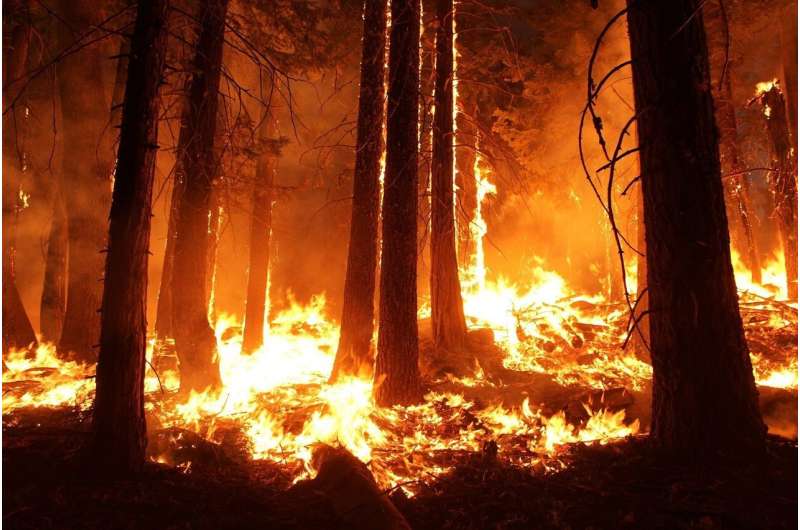
One of the strongest themes to emerge from the research was the growing impact of more frequent and intense bushfires.
Extreme 'fire weather' is likely to shorten the time between major fires, potentially transforming vegetation structure and threatening the survival of species that depend on long intervals between fires.
"Some important vegetation types, such as rainforests, depend on long intervals between hot fires. As extreme fire weather becomes more common, it will become harder and harder to maintain those ecosystems," Professor Westoby says.
The research also explored how future technologies will shape conservation outcomes. For example, gene modification to suppress invasive weeds like buffel grass (Cenchrus ciliaris) that alter fire regimes and prevent native ecosystems from recovering.
Another scenario is large-scale replacement of livestock production with lab-grown meat and dairy products, potentially freeing up vast areas of grazing land for ecosystem restoration or the establishment of new habitats of less flammable plants.
Professor Westoby says conservation policy may need to move beyond measuring success by similarity to past ecosystems.
"What if livestock for milk and meat production came to be replaced by lab-grown equivalents? That would mean changed land use in a lot of places. For example, there would be opportunities to grow key rainforest species further south," Professor Westoby says.
"There are genetic methods on the horizon for suppressing some invasive species that have strong effects on ecosystems. This would open up new possibilities.
"There is a lot of uncertainty about the future of ecosystems. Research can work out the possibilities and perhaps can open up new options."
More information
Mark Westoby et al, Scenarios for ecosystems in the year 2100, Australian Journal of Botany (2026). DOI: 10.1071/bt26036
Who's behind this story?

MA in English, copy editor since 2021 with experience in higher education and health content. Dedicated to trustworthy science news. Full profile →

Master's in physics with research experience. Long-time science news enthusiast. Plays key role in Science X's editorial success. Full profile →
Citation: Lab-grown meat, gene editing and extreme fire: Researchers' predictions for life in the 2100s (2026, July 14) retrieved 14 July 2026 from https://phys.org/news/2026-07-lab-grown-meat-gene-extreme.html
This document is subject to copyright. Apart from any fair dealing for the purpose of private study or research, no part may be reproduced without the written permission. The content is provided for information purposes only.