New model maps solar storms across 1 million miles around Earth
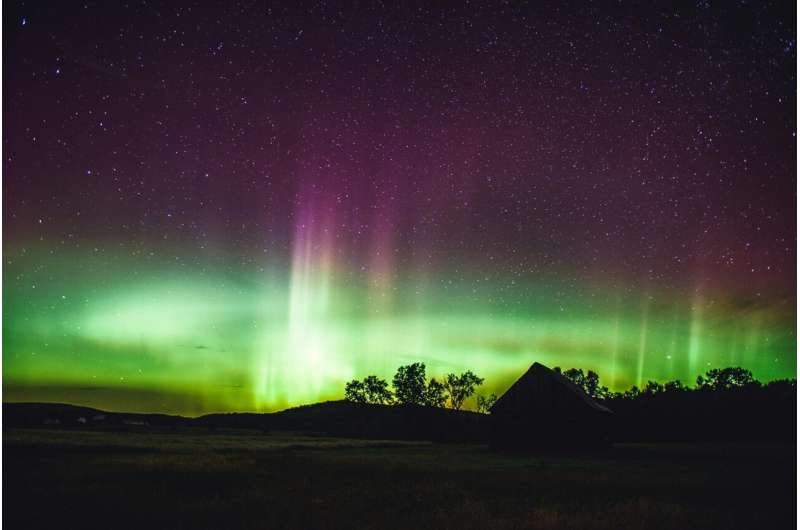
A team at the Applied Physics Lab is working to understand the complex science behind predicting invisible threats that can quickly cripple electric grid infrastructure on Earth.
On the morning of Sept. 1, 1859, telegraph operators all over North America and Europe suddenly lost control of their machines. Lines disconnected. Wires sparked and caught fire. Operators received electric shocks.
The source of this widespread disturbance was more than 150 million kilometers (more than 93 million miles) away: the sun. That night, a solar storm caused brilliant auroras to appear far beyond Earth's poles, waking people in some regions who mistook the light for morning.
More than a century later, in a world reliant on electricity, another solar storm hit. On March 13, 1989, the disturbance collapsed the power grid of the province of Quebec in less than two minutes, leaving millions without electricity for hours.
From telegraphs to satellites
Scientists describe this invisible threat as space weather. It begins with the sun's volatility: solar flares and coronal mass ejections that send out bursts of energy and charged particles through space. When those disturbances arrive at Earth, they don't strike the ground directly. Instead, they interact with the planet's magnetic field and upper atmosphere, setting off a chain of effects that scientists are trying to better understand.
"We don't really know when these storms are going to happen, how intense they'll be, or how long they'll last," says Ian Cohen, a space physicist at the Johns Hopkins University Applied Physics Laboratory with expertise in space weather.
In today's world, these disturbances can interfere with the technologies that keep our daily lives churning. GPS signals can become unreliable, nudging planes or ships off course. Electrical currents can surge through transmission lines, shutting down parts of the power grid. In orbit, satellites can lose altitude as the atmosphere expands, throwing off their trajectories.
If an extreme solar storm like the one in 1859, dubbed the Carrington Event, took place now, these impacts would play out across a far more connected and space-dependent world.
"We're putting more and more stuff into space, and we're seeing the effects of what that means when space weather hits," Cohen says.
Filling the geospace blind spot
Space weather remains difficult to predict. Scientists can track activity on the sun and conditions near Earth, but much less is known about what happens in between. Only a handful of spacecraft monitor the region around Earth, known as geospace, leaving large gaps in what scientists can directly observe.
"We don't yet have a full understanding of the physical complexity of geospace," says Slava Merkin, director of the APL-led NASA DRIVE (Diversify, Realize, Integrate, Venture, Educate) Science Center for Geospace Storms.
A computer model the center developed, called MAGE, is attempting to close that gap.
Short for Multiscale Atmosphere Geospace Environment, MAGE simulates an area roughly 1.6 million kilometers (1 million miles) around Earth. The large-scale computer model brings together different regions, including the magnetosphere, upper atmosphere and surrounding space, to track how energy from a solar storm travels through that environment and down to the technologies it can disrupt.
Earlier models treated these regions separately. MAGE stitches them together, providing a more complete view of how disturbances spread through geospace—similar to how weather models on Earth can combine data from oceans, atmosphere and land into a unified forecast model.
"We're trying to learn to understand it as a complex system, just like weather prediction or climate prediction," Merkin says.
The model is a collaboration through NASA's DRIVE, with APL leading a network of research institutions across the country. In 2025, the team released MAGE as an open-source tool for researchers worldwide.
Testing storms after they strike
Right now, nothing can reliably predict when the sun will erupt. Instead, MAGE simulates what happens after a solar event begins and reaches Earth.
In February 2022, researchers used the model to reconstruct a geomagnetic storm that affected a batch of newly launched Starlink satellites. Within days, dozens of them had lost altitude. MAGE showed how the storm heated and expanded Earth's upper atmosphere, thickening the air and increasing drag on the satellites.
During a major solar storm in May 2024, one of the strongest in more than two decades, researchers used MAGE to simulate how disruptions rippled through geospace as GPS signals wavered, radio communications broke down and auroras lit up unexpected skies.
Beyond Earth, the consequences of space weather are even more immediate. For astronauts traveling outside Earth's magnetic field, solar events can mean direct exposure to radiation. As space missions push astronauts deeper afield, from a return to the moon to future expeditions to Mars, the distance between humans and the erratic sun is only shrinking.
"MAGE is one of the tools that's going to help us transform how we understand and predict all this," Merkin says. "That could eventually give us more time to respond."
Who's behind this story?

BSc Life Sciences & Ecology. Microbiology lab background with pharmaceutical news experience in oil, gas, and renewable industries. Full profile →

Master's in physics with research experience. Long-time science news enthusiast. Plays key role in Science X's editorial success. Full profile →
Citation: New model maps solar storms across 1 million miles around Earth (2026, July 10) retrieved 11 July 2026 from https://phys.org/news/2026-07-solar-storms-million-miles-earth.html
This document is subject to copyright. Apart from any fair dealing for the purpose of private study or research, no part may be reproduced without the written permission. The content is provided for information purposes only.