Verse from the waste land: Rotterdam’s poetic bin lorries granted cultural status
It is best known for its rich migration history and striking modern architecture. But now the Dutch city of Rotterdam is seeking recognition for a rather different characteristic: its tradition of printing poetry on bin trucks.
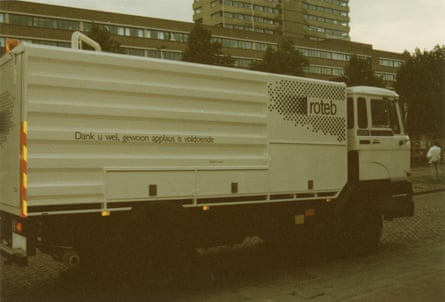
Since a poetry festival first came up with the idea in 1988, lines of verse have been printed on all of the city’s waste vehicles. The practice was this week elevated to the status of intangible cultural heritage, with formal recognition from a Dutch body that guards the nation’s traditions.
“Since 1988, poetry has been travelling through Rotterdam on our bin lorries,” said Joan Nunnely, the deputy mayor for culture, community and language. “You see it as you cycle to work or wait for a lorry to pass. Sometimes you read a line that stays with you for the rest of the day. What started as a quirky idea has become part of our city.”
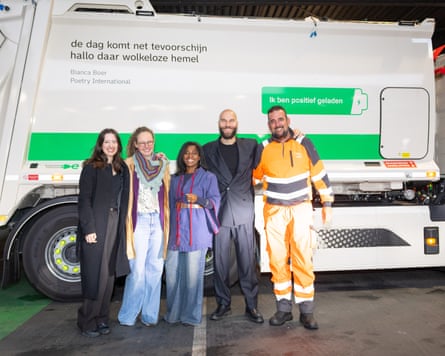
The programme is democratising as well as uplifting, say its proponents. “Sometimes people think about culture as something only for those with a theoretical education,” said Nunnely. “This is one way to bring poetry to all Rotterdammers.”
For waste collection workers such as Paul Keijzer, who started driving Rotterdam litter trucks in 1988, the poetry gives an added connection to the city. He has even been inspired to write the odd line himself, he said, while the four trucks he has so far driven inspire all kinds of responses.
“We get positive reactions that people have never seen anything like it,” he said. “But sometimes they say: I don’t understand that line!” His truck currently bears a verse from Neeltje Maria Min:
Hoe langer ik terugkijk hoe
Strakker de knoop in de tijd.
Or: The longer I look back the
Tighter the knot in time.
Diana Chin-A-Fat, director of Poetry International, which came up with the initiative, said they and Rotterdam municipality had approached the heritage body with a plan to preserve this tradition. “It’s become so much a part of the city,” she said. “Every Rotterdammer recognises it. Every Rotterdammer reads it. It’s unique.”
Poet and spoken word artist Derek Otte said it also demonstrated how Rotterdam was carving out a modern identity. “You can switch Amsterdam for Leiden or Delft and they are all beautiful – but Rotterdam is something else,” he said. “That initial idea was to combine something beautiful like poetry with something beautiful in a different way, like the garbage trucks. It’s a way to say the important things in life, in as few words as possible.”
His own words have recently joined the fleet. In Dutch, they read:
Van stenen gaat een stad de hoogte in
De mensen geven diepte.
Or: Stones build a city high.
The people give it depth.
In its inventory of more than 400 traditions, crafts, rituals and customs, the Dutch Centre for Intangible Cultural Heritage aims to document the Netherlands’ unique cultural characteristics. These range from the annual Pride Amsterdam festival and its parade of colourful boats along the capital’s canals to the 10 remaining shepherded flocks of sheep.
Several Dutch traditions are recognised in Unesco’s international list, such as traditional irrigation and the craft of the miller operating windmills and watermills.