
1944 Steel Wheat Penny Coin Value (Errors List, D, S & No Mint Mark Worth)
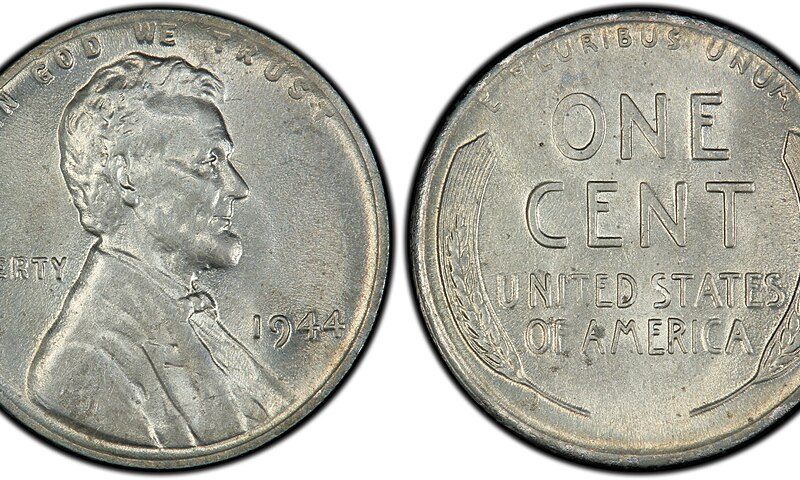
A 1944 steel wheat penny is worth $35,000 to over $450,000 depending on mint mark and condition. This makes it one of the most valuable modern U.S. error coins, with comparable rarity to varieties like the 1859 Indian Head penny. In contrast, common 1944 copper wheat pennies in circulated condition are worth only $0.10 to $5. The highly sought-after 1944-D/S overmintmark error, where a D is stamped over an S, starts at $35 and can exceed $8,000 for high-grade examples.
- 1944 steel pennies are extremely rare transition errors: only 30-50 Philadelphia, 7-10 Denver, and 2 San Francisco examples are known.
- The 1944-D/S overmintmark error, where a D is stamped over an S, is worth $35 to $8,000+ depending on condition, with high-grade examples selling for over $8,000.
- Authentic 1944 steel pennies weigh 2.70 grams and are magnetic, while copper cents weigh 3.11 grams and are not magnetic—always use a magnet to avoid copper-plated fakes.
1944 Steel Wheat Penny Values: D, S, and No Mint Mark Breakdown
1944 Steel Penny Values: No Mint Mark, D, and S Compared
The rarity and value of 1944 steel wheat pennies vary dramatically by mint mark. These coins are transition errors from leftover 1943 steel planchets.
| Mint Mark | Known Examples | Value Range | Notable Record |
|---|---|---|---|
| No Mint Mark (Philadelphia) | ~30-50 known | $35,000 – $450,000+ | Condition-dependent; top examples exceed $450,000 |
| D (Denver) | 7-10 known | $35,000 – $115,000+ | Record price $115,000+ |
| S (San Francisco) | only 2 known | $400,000+ | Extreme rarity; valued over $400,000 |
Condition is the primary driver of value within these ranges. A magnet test and precise weighing are essential for authentication.
1944-D Steel Penny: A Major 20th-Century Mint Error
“The 1944-D steel cent stands as a major 20th-century mint error.” – CoinWeek
The 1944-D steel penny is a significant rarity. Only 7 to 10 examples are known to exist. Its value stems from its extreme scarcity and the historical context of its creation. During 1944, the U.S. Mint had switched back to copper (from reclaimed ammunition shells) for pennies. The few steel planchets left over from 1943 production were accidentally used at the Denver Mint, creating this error. The combination of low survival rate and high collector demand pushes values into the six figures. A record auction price exceeding $115,000 has been documented for a high-grade specimen.
1944-S Steel Penny: The Rarest of All
“Extremely rare, only 2 known, valued at over $400,000.” – AIO
The 1944-S steel penny is the undisputed king of 1944 errors. With only two confirmed examples known to collectors, it represents the pinnacle of rarity for this issue. Its value reflects this extreme scarcity, with estimates consistently placing it above $400,000. The near-total absence of this variety suggests that virtually all 1944-S steel planchets were identified and melted down at the San Francisco Mint before they could enter circulation. Owning one is akin to possessing a major numismatic treasure.
How to Identify a Real 1944 Steel Penny vs. Fake
Given the immense value of genuine 1944 steel pennies, counterfeits—primarily copper-plated steel or altered dates—are a serious concern. Follow these steps to verify authenticity:
- Magnet Test: Steel is magnetic. Copper is not. A genuine 1944 steel cent will be strongly attracted to a magnet. A copper 1944 penny will not.
- Weight Check: Use a precise scale. A genuine 1944 steel penny weighs 2.70 grams. A standard 1944 copper penny weighs 3.11 grams. This 0.41-gram difference is a critical diagnostic.
- Visual Inspection: Examine the coin under good light. Genuine steel cents have a distinct zinc coating that may appear dull gray or show signs of oxidation. Look for any signs of plating or uneven color that suggest a copper core.
- Professional Authentication: For any coin that passes the initial tests, professional grading by a service like PCGS or NGC is non-negotiable. Their experts use advanced techniques to confirm authenticity and assign a grade that directly impacts market value. Always remember: “Always use a magnet to identify a true 1944 steel cent.” (AIO)
What Is the 1944-D/S Overmintmark Error?
Understanding the D/S Overmintmark Error
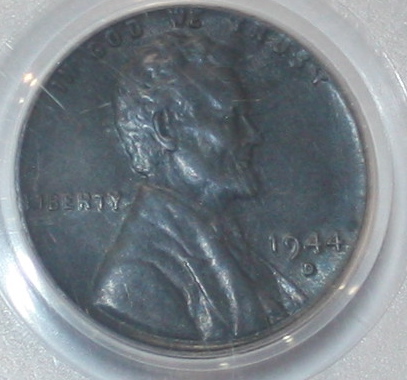
The 1944-D/S error is a fascinating and well-documented mint mistake. It occurs when the Denver Mint used a die that originally had an “S” mint mark (from San Francisco) and then punched a “D” over it. This created a visible, overlapping mint mark where both letters can be seen, most clearly under magnification.
“Denver used dies with underlying San Francisco mint marks, creating visible D over S worth $50-$5,000+ depending on grade.” – Republic World
This is not a “doubled die” in the typical sense but an overpunched or overmintmark error. It is a recognized variety that commands a significant premium over a normal 1944-D copper penny. Even in well-circulated condition, these coins start at a minimum of $35. The error provides a direct physical link to the die-making practices of the era and is a highly collectible variety.
1944-D/S Error Values by Condition: From $35 to $8,000+
The value of a 1944-D/S overmintmark penny increases exponentially with its condition grade. The following table outlines typical value ranges based on third-party grading.
| Condition Grade | Value Range (USD) |
|---|---|
| Good (G-4) to Very Good (VG-8) | $35 – $100 |
| Fine (F-12) to Very Fine (VF-20) | $100 – $500 |
| Extremely Fine (EF-40) to About Uncirculated (AU-50) | $500 – $2,000 |
| Mint State (MS-60 to MS-63) | $1,000 – $5,000 |
| High Mint State (MS-64 to MS-67+) | $5,000 – $8,000+ |
An exceptional auction record of $115,000 was achieved for an MS-63 specimen, highlighting the premium for top-tier examples (Source: coin-identifier.com). Such prices are outliers but demonstrate the ceiling for this variety.
How to Spot a Genuine 1944-D/S Overmintmark
Identifying this error requires careful examination. Here is a practical checklist:
- Magnification is Essential: Use at least 10x magnification. Look closely at the mint mark area just left of the wheat stalk on the reverse.
- Look for the Underlying “S”: The key diagnostic is seeing part of the original “S” mint mark protruding from beneath the overstamped “D”. The top curve of the “S” is often visible.
- Assess the “D”: The overstamped “D” may appear slightly distorted, wider, or misaligned compared to a normal 1944-D mint mark.
- Check for Other Die Traits: Genuine errors often have other minor die characteristics. Be wary of coins that look too perfect or where the “D/S” appears artificially added.
- Seek Expert Opinion: For any coin you suspect is a 1944-D/S, professional grading is the only way to verify the variety and secure its full market value. Many common 1944 copper cents are still in circulation, so every coin deserves a close look.
Standard 1944 Copper Penny Values: D, S, and No Mint Mark
1944 (No Mint Mark) Copper Penny: $0.10 – $0.90 Circulated
The vast majority of 1944 wheat pennies are common copper coins from the Philadelphia Mint, which used no mint mark. Over 1.4 billion were produced. These coins are made from copper reclaimed from spent ammunition shells, a historical footnote from World War II. In average circulated condition (showing wear but no major damage), they are worth face value plus a small premium, typically between $0.10 and $0.90.
Higher grades command more for 1944 (No Mint Mark) copper pennies, as they do for 1863 Indian Head pennies. According to NGC pricing, a 1944 (No Mint Mark) in Mint State 63 Red (MS-63 RD) lists for $8.25, while a pristine MS-67 Red can reach $150. The ‘Red’ (RD) designation, indicating full original mint luster, is a key factor in these higher valuations.
1944-D and 1944-S Copper Pennies: $1 – $5+ Range
Pennies from the Denver (D) and San Francisco (S) Mints are also common in lower grades but show slightly higher base values than Philadelphia issues. Their values are also heavily influenced by condition and color.
| Mint Mark | Circulated Value | MS-63 Value | MS-67 Value |
|---|---|---|---|
| 1944-D | $1 – $5+ | MS-63 RD: $8.25 | MS-67 RD: $150 |
| 1944-S | $1 – $5+ | MS-63 BN: $2.50 MS-63 RB: $2.75 |
MS-67 BN: $40 MS-67 RB: $50 |
Data Source: NGC (ngccoin.com). Note: RD = Red, RB = Red-Brown, BN = Brown. Color significantly impacts value, with full Red (RD) being most desirable.
Why Condition Grading Matters for 1944 Copper Pennies
For common 1944 copper pennies, condition is everything. The grading scale runs from Good (G-4), where heavy wear is evident, up to Mint State (MS-70), where no wear is visible. Value increases at each step.
- Circulated Grades (G-4 to VF-20): Value is minimal, often just a few cents to a few dollars. A heavily worn 1944-D might be worth $1, while a nicely worn one could be $3.
- About Uncirculated (AU-50): Minimal wear on high points. Values begin to climb notably.
- Mint State (MS-60+): No circulation wear. An MS-63 1944-D is valued at $8.25 by NGC. An MS-67 of the same mint can be $150—nearly 20 times more.
- Color is Critical: For copper coins, the original mint luster color (Red, Red-Brown, Brown) is a major value component. A “Red” coin of a given grade is worth substantially more than a “Brown” coin of the same grade.
The takeaway: if you have a 1944 copper penny, do not clean it. Store it carefully and consider professional grading if it appears to be in very good condition. A small difference in grade or color can mean a large difference in value.
The single most surprising fact from this research is the existence of only two confirmed 1944-S steel pennies. Their value exceeding $400,000 places them among the most valuable U.S. error coins. If you suspect you have a 1944 steel penny—whether no mint mark, D, or S—your immediate action steps are clear: first, weigh it precisely (it must be 2.70 grams) and test it with a magnet (it must be magnetic). If it passes both tests, the next and final step is to submit it to a professional grading service like PCGS or NGC for authentication and grading. This is the only way to unlock its full market value and verify its rarity. For standard 1944 copper pennies, the action is simpler: check your change and old coin rolls for any 1944 dates, as finding one in excellent condition can still yield a pleasant return.
Related Coins
 Penny
Penny
1993 Penny Value 2026: Errors List, D, S & No Mint Mark Worth
Discover 1993 penny values for 2026. Learn about rare errors like the $50,000 mule, Close AM ($50-$300+), and values for D, S, no mint mark coins. Get latest prices.
 Penny
Penny
1914 Wheat Penny Coin Value (Errors List, “D”, “S” & No Mint Mark Worth)
Current 1914 Wheat Penny values: $1-$20+ for no mint mark, $10-$50+ for 1914-S, $150-$5,000+ for 1914-D. Error varieties like Weak D, RPM, Rotated Reverse increase value. Avoid counterfeits.
 Penny
Penny
1942 Wheat Penny Coin Value (Errors List, D, S & No Mint Mark Worth) – 2026 Guide
2026 value guide for 1942 Wheat Pennies. Get prices for no mint mark, D, S, errors (DDO, RPM), and what makes them valuable. Updated market data.