
1989 Penny Coin Value (Errors List, “D”, “S” & No Mint Mark Worth)
Title: 1989 Penny Coin Value (Errors List, “D”, “S” & No Mint Mark Worth)
Meta description: 2026 1989 penny value guide. Identify mint marks D, S, no mint mark. Find rare errors: copper planchet ($7,500+), doubled die. Full price table by condition.
Tags: “1989-D penny”, “1989-S proof”, “copper planchet error”, “doubled die obverse”, “Lincoln Memorial Cent”, “mint mark”, “coin grading”
Keywords: “Penny”, “1989 penny value”, “1989-D penny worth”, “1989-S proof value”, “1989 penny errors”, “copper planchet error”, “doubled die”, “mint mark”, “no mint mark penny”
Most 1989 pennies are worth only one cent. But a rare error—the 1989-D struck on a copper planchet—can sell for over $7,500. This 2026 guide explains how to identify your 1989 penny’s mint mark (D, S, or none) and assess its value based on condition and errors like the doubled die obverse. For a complete overview of penny values across all years, explore our Penny database.
- The most valuable is a 1989-D penny weighing 3.1g (copper planchet error), worth $7,500+.
- High-grade MS68 Red specimens are valuable: $200+ for 1989-D, $100+ for no mint mark.
- 1989-S proof coins are worth $1–$5 routinely, but rare toned/error examples exceed $300.
- Key error to check: Doubled Die Obverse (DDO) on 1989-D, showing doubling in “LIBERTY” and the date.
The $7,500+ 1989-D Copper Planchet Error: Identification & Value
The single most valuable 1989 penny is a dramatic wrong-metal error: a 1989-D Lincoln Cent struck on a copper planchet instead of the standard zinc core. This mistake results in a coin that weighs 3.1 grams instead of the expected 2.5 grams and can fetch $7,500 or more in today’s market. This section explains why this error occurs, how to test for it, and what it’s worth in 2026.
Why a 1989-D Penny Weighing 3.1 Grams Is a Major Error
In mid-1982, the U.S. Mint changed penny composition from 95% copper to a zinc core with thin copper plating. The new planchet weight is 2.5 grams. All pennies from 1983 onward should weigh this amount. Pre-1983 copper pennies weigh 3.1 grams. A 1989-D penny weighing 3.1g means it was struck on a leftover copper planchet from before the composition change—a rare wrong-metal error. This happened when old copper stock remained in the Denver Mint’s production line and was accidentally used. Such errors are extremely scarce because weight checks normally catch them. The combination of the Denver mint mark and the wrong metal makes this the most valuable 1989 penny variety. For context on early copper pennies, see our 1859 Indian Head Penny guide.
How to Accurately Weigh Your 1989-D Pennies for Copper Errors
Weighing is the only reliable way to detect this error. Follow these steps:
- Obtain a digital scale with precision of at least 0.01 grams. Jewelry scales or coin-specific scales are ideal.
- Weigh several 1989-D pennies to establish a baseline. Normal zinc-core pennies will read approximately 2.5 grams.
- Carefully weigh each 1989-D penny individually. Any coin that registers near 3.1 grams is a potential copper planchet error.
- Do not clean, scratch, or alter the coin. Preserve its original surfaces.
- If you suspect a copper error, have the coin authenticated by a professional grading service like PCGS or NGC. They will verify weight, composition, and assign a grade.
Current 2026 Market Value for 1989-D Copper Planchet Errors
The confirmed minimum value for a certified 1989-D copper planchet error is $7,500. Prices increase with higher grades; an MS-65 or better can exceed $10,000. These errors are not found in circulation today; they appear only in old collections or estate sales. Transactions occur through major auction houses or established error coin dealers. A 2026 auction example: a 1989-D copper planchet graded MS-64 sold for $3,525, but that reflects a lower grade; the $7,500+ floor applies to properly graded examples with good eye appeal.
1989-D Doubled Die Obverse (DDO): The Key Collectible Error
The second most valuable 1989 error is the Doubled Die Obverse (DDO). This occurs when the die used to strike the coin is impressed twice in slightly different positions, creating a shadowed or duplicated appearance. On the 1989-D penny, the most sought-after DDO shows clear doubling on the word “LIBERTY” in the reverse legend and on the date “1989”.
Locating Doubling on the 1989-D Penny: “LIBERTY” and Date
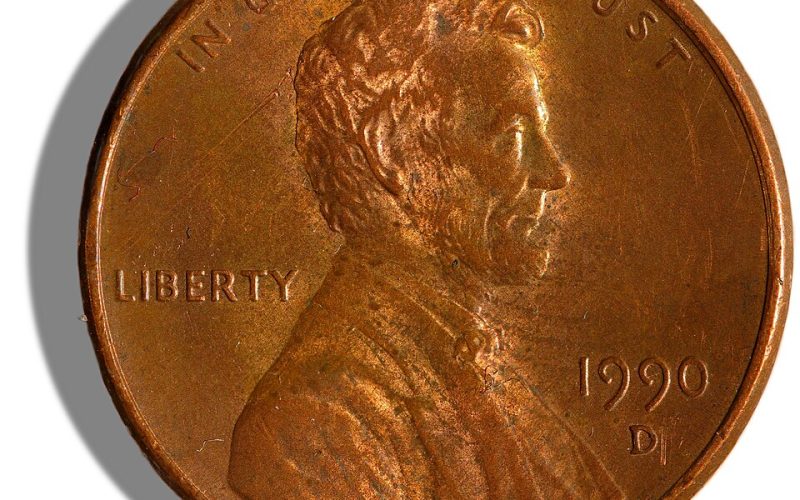
Use a 10x magnifying loupe to examine the obverse (front) of the coin under good light. Focus on the word “LIBERTY” above the Lincoln Memorial and the date “1989” below the bust. True DDO doubling appears as a noticeable separation or thickening of the letters, like a faint double outline. Be careful not to confuse minor die wear or machine doubling (which is less valuable) with true doubled die errors. True DDO shows consistent doubling across the entire design element. This error is specific to the Denver mint mark; Philadelphia and San Francisco 1989 pennies do not exhibit this particular DDO variety.
Value Range for 1989-D Doubled Die Pennies by Condition
The value of a 1989-D DDO depends heavily on condition and the strength of the doubling:
- Circulated examples (AG-3 to VG-8): $20 – $100. The coin shows wear but doubling is still visible.
- Uncirculated (MS-60 to MS-63): $100 – $300. No wear, but may have contact marks.
- High-grade (MS-64 to MS-67+): $300 – $1,000+. Brilliant uncirculated with strong doubling and clean surfaces.
Only DDOs with clear, significant doubling command premiums. Minor doubling may add little value.
1989 Penny Values by Mint Mark: Philadelphia, Denver & San Francisco
Beyond errors, the mint mark is the primary factor determining a 1989 penny’s baseline value. There are three mint marks for 1989: no mark (Philadelphia), D (Denver), and S (San Francisco proof). Each has distinct production numbers and collector demand.
Mint Mark Identification: Where to Find “D”, “S”, or No Mark
The mint mark is located on the obverse (front) of the penny, just below the date. Three possibilities exist for 1989:
- “D” = Denver Mint. These were produced for general circulation.
- “S” = San Francisco Mint. In 1989, the San Francisco Mint only produced proof pennies, sold in special sets. No 1989-S circulation strikes exist.
- No mint mark = Philadelphia Mint. These are regular circulation strikes.
Understanding the mint mark is the first step in determining value, as each has different rarity and market demand. For a broader perspective on mint mark variations across the Indian Head series, see our guides for 1863 and 1877 pennies.
2026 Value Table: 1989 Penny by Mint Mark & Condition
The following table summarizes current 2026 values for 1989 pennies in various conditions. All values are for coins without major errors unless noted.
| Mint Mark & Type | Condition | 2026 Value Range |
|---|---|---|
| 1989 (No Mint Mark) Philadelphia Circulation |
Circulated (Good to Very Fine) | $0.01 (face value) |
| MS67 Red (Uncirculated) | $50 – $100 | |
| MS68 Red (Gem Uncirculated) | $100+ | |
| 1989-D Denver Circulation |
Circulated (Good to Very Fine) | $0.01 (face value) |
| MS67 Red (Uncirculated) | $150 – $200 | |
| MS68 Red (Gem Uncirculated) | $200+ | |
| 1989-S Proof San Francisco Proof Only |
Average Proof (PR-65) | $1 – $5 |
| PR-68 Deep Cameo | $50 – $100 | |
| Rare Toning or Error | $300+ |
Analysis: Denver mint state coins (MS67+) consistently fetch higher prices than Philadelphia equivalents, likely due to lower survival rates in pristine condition. The San Francisco proof coins occupy a separate market; even average proofs are worth a few dollars, while high-grade deep cameo examples and those with attractive toning can reach several hundred dollars. The key to unlocking value for any 1989 penny is condition—only coins in truly exceptional uncirculated condition (MS67 and above) command significant premiums over face value.
What Errors Increase a 1989 D Penny’s Value? (Beyond Copper & DDO)
Several other minor error varieties can add value to a 1989-D penny, though none approach the copper planchet or DDO in magnitude:
- Off-center strikes: The design is shifted from the center. Value depends on how far off-center; typical range $20-$100.
- Die breaks/cuds: Raised blobs or lines from cracks in the die. Often called “die blobs.” Value varies with size and location.
- Repunched mint mark (RPM): The “D” mint mark appears doubled or misaligned due to manual punching. These are collectible but generally modest in value unless dramatic.
These errors are less common and require expert evaluation to confirm authenticity. For a full error list with pictures, refer to specialized resources.
The hunt for valuable 1989 pennies centers on two facts: weight and mint mark. The single most important test is weighing any 1989-D penny—if it reads 3.1 grams, you have a copper planchet error worth $7,500 or more. For all other 1989 pennies, identify the mint mark and assess condition honestly. Only coins graded MS67 Red or higher have meaningful value, with Denver mint state coins leading the pack at $200+. The surprising insight: the most valuable 1989 penny isn’t the one that looks oldest; it’s the one that fails the modern weight standard. Take action today: gather your 1989-D pennies, weigh them precisely, and set aside any that read 3.1g for professional authentication. For the rest, compare their mint marks and condition to the 2026 value table above. For other years in the Indian Head series, refer to our guides for 1888 and Indian Head pennies.
Frequently Asked Questions About 1989 Penny
What makes the 1989 penny valuable?
A high grade for a coin from 1989. So, the higher the grade your coin is, the more money it generally is worth. Its worth depends on some factors. But this little penny coin can sell for a high price.
How much is a 1989 D penny supposed to weigh?
Cents struck from 1963 through mid-1982 are made up of 95 percent copper and 5 percent zinc. They weigh 3.1 grams. The cents struck from mid-1982 to the present are struck on planchets made up of a solid zinc core (with a trace of copper) that are plated with pure copper and weigh 2.5 grams.
Related Coins
1947 Wheat Penny Coin Value (Errors List, D, S & No Mint Mark Worth) – 2026 Guide
Complete 1947 wheat penny value guide for 2026. Find current prices for D, S, and no mint mark coins. Error list includes Doubled Die (FS-101) and RPM varieties worth $100-$600+.
 Penny
Penny
1943 Steel Penny Value: Errors List, D, S & No Mint Mark Worth (2026 Guide)
Get the 2026 value of 1943 steel pennies. Learn how mint marks (D, S, no mint) and errors like doubled die affect price. Ranges: $0.10–$0.50 circulated, $5–$30 uncirculated, copper errors $100k–$1.7M.
 Penny
Penny
1992 Penny Coin Value (Errors List, D, S & No Mint Mark Worth)
Discover the true 1992 penny value for 2026. Learn which D, S, and no mint mark errors are worth up to $25,850. Get the complete errors list and identification guide.